
A parking lot camera that records a face as a blur or a license plate as a white rectangle has not done its job. Parking areas are difficult security environments: vehicles move quickly, headlights create glare, people enter from several directions, and incidents often happen after business hours. The best cameras for parking lots are selected and positioned to produce usable evidence, not simply broad video coverage.
For commercial properties, multifamily buildings, warehouses, retail centers, and medical offices, the right design can deter theft, support incident investigations, and help staff respond before a problem grows. It also needs to work reliably through rain, darkness, changing seasons, and busy daily traffic.
What Makes a Parking Lot Camera Effective?
Camera quality matters, but a successful system depends on matching the camera type to the job. A wide overview camera cannot reliably identify a plate at a driveway. A license plate camera aimed at one lane cannot replace broad coverage of pedestrian paths. Most well-designed parking lot systems use a combination of views.
Start by defining what the footage must prove. Do you need to see whether a vehicle entered the property, identify the driver, read a license plate, monitor a loading area, or document activity around parked cars? Each objective affects the lens, mounting height, angle, lighting requirements, and camera placement.
A professional site assessment should also account for traffic flow, property boundaries, entrances, blind corners, landscaping, overhead lights, and network access. Installing a high-resolution camera in the wrong position is still a poor security decision.
Best Cameras for Parking Lots by Coverage Need
Varifocal turret cameras for entrances and key zones
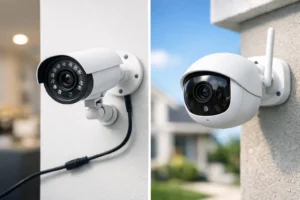
Varifocal turret cameras are often the strongest all-around choice for parking lot entrances, payment stations, loading areas, dumpster enclosures, and building approaches. Their adjustable lens allows the installer to set the field of view for the distance and detail required at that location.
Compared with a fixed-lens camera, a varifocal model provides more flexibility when the exact viewing angle is uncertain. It can be configured for a wider view of an entrance or tightened to capture faces and vehicle details at a controlled choke point. Turret housings also tend to perform well in outdoor environments because they are less prone to infrared reflection than some dome designs.
For most properties, look for at least 4K resolution in priority areas. Higher resolution can preserve more detail when footage is reviewed or digitally cropped, but it should not be treated as a substitute for proper lens selection.
License plate recognition cameras for driveways
A dedicated license plate recognition camera is the right tool for a vehicle entrance or exit where plate capture matters. These cameras are configured for a specific lane, speed range, distance, and angle. They use specialized settings to manage headlights, motion, and contrast that can defeat a standard overview camera.
Plate recognition is especially useful for strata properties, industrial yards, gated facilities, commercial lots with recurring vandalism, and businesses that need a record of after-hours vehicle activity. It works best when vehicles pass through a defined entry point. Trying to capture every plate across an open, multi-row parking lot is usually unrealistic.
The trade-off is a narrower field of view. A plate camera should be paired with an overview camera that shows the vehicle, direction of travel, and surrounding activity. Together, those views provide much stronger evidence than either camera alone.
Pan-tilt-zoom cameras for large active properties
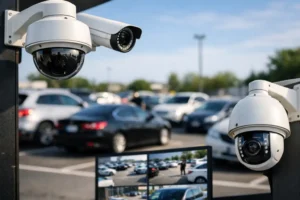
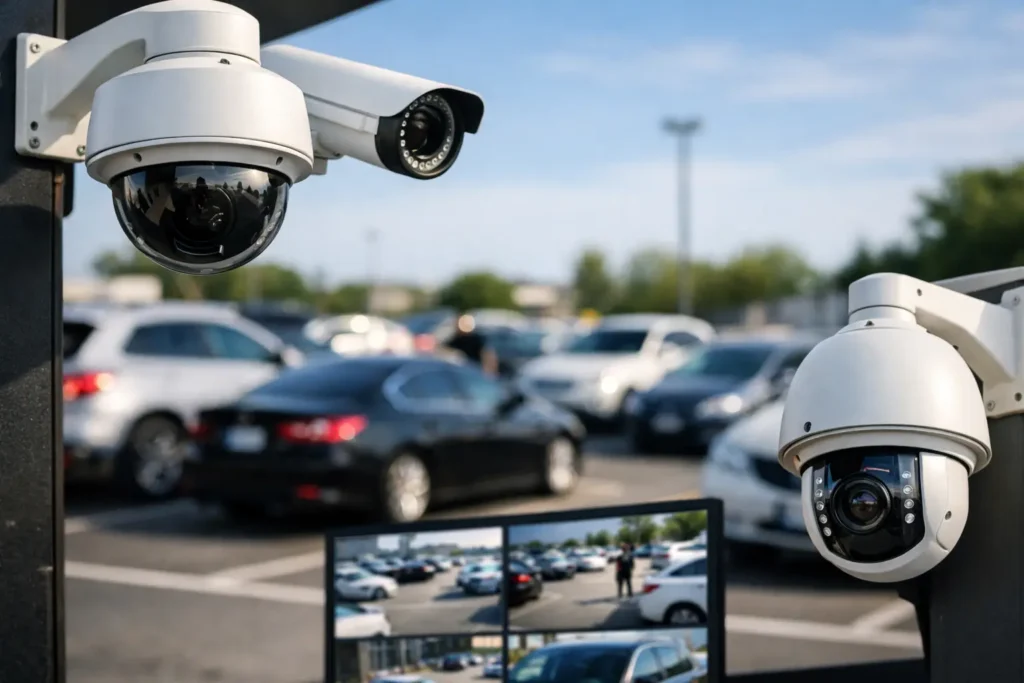
Pan-tilt-zoom, or PTZ, cameras can rotate, tilt, and zoom to follow activity across a large area. They are valuable for warehouses, large retail sites, construction staging areas, apartment complexes, and industrial facilities with active monitoring needs.
A PTZ camera is most useful when someone can actively operate it through a monitoring station or mobile app. It can be directed toward suspicious activity, a gate incident, or a delivery area in real time. Preset patrol routes can also scan important zones on a schedule.
However, a PTZ is not a replacement for fixed cameras. While it is pointed in one direction, it is not recording detail elsewhere. Fixed cameras should cover critical entrances, pedestrian routes, and parking rows continuously, with PTZ coverage added for live response and broader observation.
Multi-sensor cameras for wide, uninterrupted views
Multi-sensor cameras place several lenses in one housing to cover a wide space with fewer mounting points. They are a practical option for open lots, corners of large buildings, and locations where installing multiple separate cameras would be disruptive or costly.
These cameras can provide a broad stitched image or multiple individual views from one location. They reduce gaps between camera angles and simplify cable runs, but the final image still needs to provide enough pixel density at the distances that matter. A wide view is valuable for situational awareness, while identification usually requires closer, focused cameras at strategic points.
Low-light cameras for night operations
Night performance is where many parking lot systems fail. Standard infrared cameras can illuminate nearby subjects well, but reflective signs, wet pavement, headlights, and distance can reduce image quality. For sites with limited lighting, low-light cameras with larger image sensors and strong color performance are often the better choice.
Color video at night can help distinguish vehicle color, clothing, and environmental details that black-and-white infrared footage may miss. It may require nearby white-light illumination, either from existing fixtures or camera-integrated lighting. That light can also act as a deterrent, though it should be aimed carefully to avoid disturbing residents, drivers, or neighboring properties.
Resolution Is Only One Part of the Decision
It is easy to focus on megapixels, but resolution is only useful when the camera has enough light, the right lens, and an appropriate angle. A camera mounted too high may show the top of a vehicle clearly while missing faces. A camera pointed across a wide lot may record activity without capturing identifying detail.
For parking areas, practical camera design follows a simple principle: use overview cameras to show what happened, and identification cameras to show who or which vehicle was involved. This layered approach creates footage that is more useful for owners, managers, police reports, insurance claims, and internal investigations.
Storage must be planned with the same care. Higher-resolution cameras, longer retention periods, continuous recording, and multiple camera views all require more storage. A business that needs 30 days of video retention has different requirements than a homeowner who needs a week of event-based clips. A network video recorder with properly sized hard drives is usually the dependable choice for larger installations.
Placement Matters More Than Camera Count
Adding cameras without a coverage plan often leaves expensive blind spots. The most valuable locations are typically vehicle entrances and exits, pedestrian access routes, spaces near building doors, loading areas, cash-handling paths, bike storage, dumpsters, and isolated corners.
Mounting height should balance protection from tampering with a usable facial angle. Cameras placed extremely high are harder to reach but may not identify a person wearing a hat or hood. Entrances often benefit from a lower, closer angle that captures faces as people approach.
Avoid aiming cameras directly into sunrise or sunset when possible. Use wide dynamic range settings to manage bright backgrounds and deep shadows. At nighttime entry points, test footage with vehicles arriving and leaving, headlights on, rather than assuming daytime image quality will carry over after dark.
Remote Access, Alerts, and System Reliability
A modern parking lot camera system should give authorized users secure remote access from a phone, tablet, or computer. Property managers can review an incident without traveling to the site, while business owners can check opening and closing activity from off-site.
Smart alerts can be useful when configured carefully. Vehicle, person, line-crossing, and intrusion alerts can notify staff when activity occurs in a restricted area or after business hours. Poorly configured alerts create constant notifications from traffic, rain, animals, and moving trees, so the system should be tuned to the property rather than left on default settings.
Reliability also depends on the network and power infrastructure behind the cameras. Commercial-grade PoE cabling, surge protection, battery backup, secure passwords, and regular health checks help keep the system operating when it is needed most. For larger sites, separating security cameras from general office or guest Wi-Fi traffic can improve performance and reduce risk.
Choose a System Designed for Your Property
There is no single best camera for every parking lot. A small retail storefront may need two well-positioned varifocal cameras and a dedicated entrance view. A strata complex may need a plate camera at the gate, fixed cameras along pedestrian paths, and low-light coverage around visitor parking. A warehouse may require broad multi-sensor coverage, PTZ support, and long-term recording capacity.
HTech Knight Security Systems Ltd designs parking lot camera systems around real site conditions, including visibility, lighting, vehicle flow, recording needs, and remote access requirements. Professional installation ensures the cameras are mounted, focused, connected, and tested for the moments that matter.
The right next step is to walk the lot after dark and ask a practical question: if an incident happened here tonight, would your current footage clearly show what happened and who was involved? If the answer is uncertain, a properly designed camera plan can provide the clarity and confidence your property needs.